How to Enrol Your Child in a Cypriot School
The thought of enrolling your child in a new school in a foreign country can be genuinely daunting, a labyrinth of unfamiliar bureaucracy, different languages, and cultural nuances. Many expat parents arriving in Cyprus quickly find themselves overwhelmed, not just by finding the right school, but by understanding the process itself. This comprehensive guide is here to untangle that knot, offering a clear, empathetic roadmap to successfully enrolling your child in a Cypriot school, whether you're eyeing public, private, or international options.
Understanding the Cypriot School System
When you first arrive in Cyprus, one of the biggest decisions, and often one of the most stressful for families, is figuring out the education system for your children. It’s not just about finding a good school; it’s about understanding the different pathways available, each with its own set of expectations, language considerations, and, of course, costs. Cyprus offers a tripartite system: state-funded public schools, private local schools, and the often-sought-after international schools. Knowing the distinctions is your first, crucial step.
Public Schools: The Free or Nearly Free Option
Ah, the public school system! For many expat families, especially those planning a longer stay and wanting their children to truly integrate into Cypriot society, public schools are the natural choice. These schools are government-funded, meaning tuition is essentially free for eligible residents, although you might have small annual fees for things like school activities, books, or stationery. The curriculum largely follows the Ministry of Education's guidelines, which are robust and academically focused. The primary language of instruction, however, is Greek.
Now, don't let the Greek language scare you off immediately. Public schools are often equipped to support non-Greek speaking children, particularly in the younger grades, with special Greek language integration classes. It’s a fantastic way for children to become truly bilingual and immerse themselves in the local culture, which can be incredibly enriching for their personal development. We've seen countless expat children, initially nervous, thrive in the public system, making Cypriot friends and picking up the language with astonishing speed. However, it's a commitment, and parents need to be prepared for the initial challenges, especially if their child is older and has less time to adapt before hitting more complex academic subjects. For a deeper dive into the overall educational landscape, you might want to read our guide on Schools and Education in Cyprus: A Complete Guide for Expat Families.
Private Schools: Balancing Local Culture with International Standards
Private schools in Cyprus often strike a balance between the local ethos and a more international outlook. They typically follow the Cypriot curriculum but may offer instruction in both Greek and English, or even entirely in English, depending on the specific school. These schools are privately funded, so tuition fees are a significant consideration, varying widely based on reputation, facilities, and location. Many families opt for private local schools as they appreciate the smaller class sizes, enhanced facilities, and sometimes a broader range of extracurricular activities compared to some public schools.
For parents who want their children to grow up understanding Cypriot traditions and history, but perhaps prefer a slightly different pedagogical approach or a more robust English-language environment than public schools might offer, private local schools are an excellent middle ground. These institutions are generally well-regarded and provide a high standard of education, often preparing students for both Cypriot and international university systems. They can offer a smoother transition for children who have some exposure to English but are new to an entirely Greek-speaking environment.
International Schools: A Familiar Environment, But at a Cost
For many expats, international schools are the default choice, and for good reason. They offer curricula like the British, American, or International Baccalaureate (IB) systems, which provide continuity for children who might move again, or whose parents plan to return to their home country. The language of instruction is almost always English, with additional languages offered as subjects. This familiarity can be a huge comfort for children, helping them settle academically and socially much faster, as they don't have to contend with a new curriculum or a new language of instruction simultaneously.
However, this comfort comes at a price. International schools are the most expensive option, with tuition fees that can easily rival those in many Western European countries. Beyond tuition, there are often additional costs for registration, uniforms, field trips, and sometimes even transport. The demand for places in top international schools, especially in major cities like Limassol and Nicosia, is very high, making early application absolutely essential. If you’re weighing the financial implications, our article on How Much Are International School Fees in Cyprus? can give you a clearer picture.
Eligibility and Documentation for Enrollment
Navigating the administrative requirements for school enrollment in Cyprus can feel like a treasure hunt, only the treasure is a school place and the map is written in a language you might not fully understand. It requires patience, meticulous organisation, and an understanding of what is expected from you as an expat parent. This isn't just about proving your child exists; it's about proving their legal right to reside and study in Cyprus, and that you're prepared for their educational journey.
Residency and Legal Requirements for Enrollment
Before any school in Cyprus will even look at your child's application, whether public, private, or international, you need to establish your family's legal right to reside in the country. For EU citizens, this typically means applying for the Yellow Slip (MEU1), which confirms your registration as an EU citizen living in Cyprus. For non-EU citizens, a valid residence permit, often referred to as a "Pink Slip" (Temporary Residence Permit), is crucial. Without these foundational documents, you'll hit a bureaucratic brick wall before you even begin the enrollment process.
It’s not just about having the permit; sometimes, schools will require proof that your application is in process if you’ve recently arrived and are awaiting approval. This can be a tightrope walk, as the timelines for residency permits can sometimes stretch, and school application deadlines are often rigid. It's a common frustration among expats, having to manage interdependent processes that don't always align perfectly. For detailed information on securing your legal status, consider consulting guides like Understanding Residence Permits and the Pink Slip in Cyprus (2027) or [How to Get a Residence Permit to Live in Cyprus (Pink Slip)].
Essential Documents You'll Need to Gather
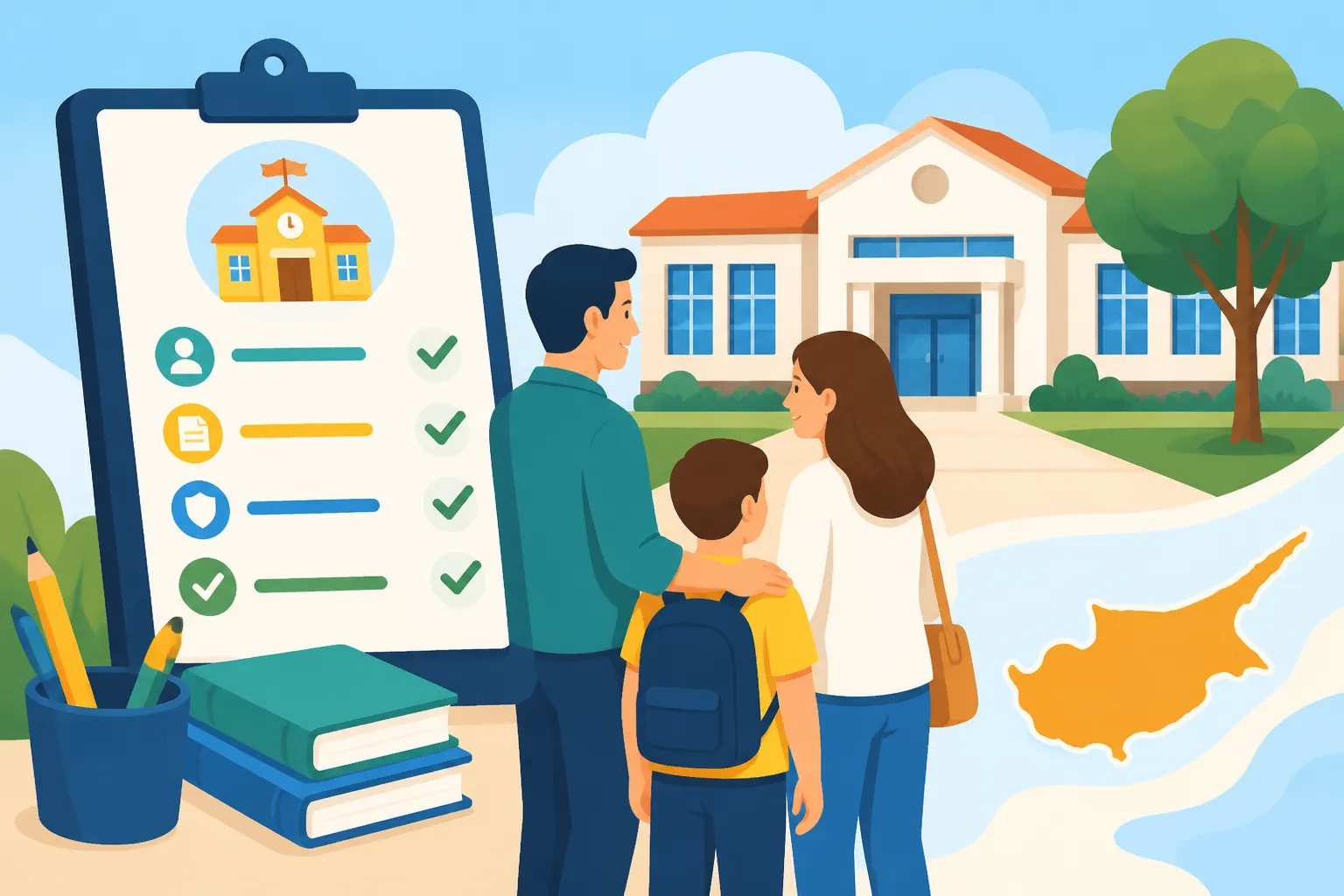
Once your residency is sorted (or at least progressing), the real document collection begins. Regardless of the type of school, you'll need a standard set of documents. These typically include:
- Child's Birth Certificate: The original, often with a certified translation into Greek or English if it's in another language.
- Parents' Passports/IDs: Copies of your passports or national ID cards, demonstrating your legal identity.
- Proof of Residency: Your Yellow Slip or Pink Slip (or proof of application).
- Utility Bill/Rental Agreement: To prove your address in Cyprus, as school catchment areas can be important for public schools.
- Previous School Records: Report cards, transcripts, or any academic assessments from your child's prior school, translated if necessary.
- Health Records/Vaccination Card: Schools need to know your child’s health status and confirm they meet national vaccination schedules. Our guide on Understanding Childhood Vaccination Schedules in Cyprus can help here.
- Photos: Passport-sized photos of your child are often required.
It’s highly advisable to have multiple copies of everything and, if possible, certified translations ready. Don't underestimate the Cypriot penchant for paperwork! A friend of mine once had to submit a certified translation of a stamp on a document that was already in English, simply because the stamp itself was in another language. It can feel excessive, but it’s best to be over-prepared.
Navigating the Application Process: Step-by-Step
The application process itself varies depending on the school type. For public schools, it usually involves visiting the local district education office or the school directly to pick up forms, fill them out, and submit them with your documents. For private and international schools, the process is generally more formal and online-driven, often involving an initial inquiry, followed by an application form, document submission, and then an assessment or interview for the child.
Here's a general sequence you can expect:
- Initial Research: Identify potential schools based on location, curriculum, and budget.
- Contact Schools: Reach out to inquire about admission requirements, deadlines, and availability. For popular international schools, this should be done months in advance, sometimes even a year.
- Gather Documents: Start collecting and translating all necessary paperwork.
- Submit Application: Complete the school’s specific application form and submit it with all supporting documents.
- Child Assessment/Interview (Private/International): Your child might need to sit for entrance exams or have an interview.
- Acceptance and Enrollment: If accepted, you'll receive an offer, which you'll need to accept by a deadline, often with a deposit.
- Final Registration: Complete any remaining paperwork and pay initial fees.
This process can be time-consuming, and communication might not always be as prompt as you'd hope. Staying organised and following up politely is key. And remember, the digital realm is your friend for initial searches; an eSIM from a provider like Airalo can ensure you have data to research schools and communicate even before you get your local SIM sorted.
The Enrollment Process in Public Schools
Enrolling your child in a public school in Cyprus is often the most economical choice, and a fantastic pathway to cultural immersion. However, it requires understanding a system that can, at times, feel less streamlined than private institutions, particularly for those unfamiliar with local administrative procedures. The key here is to embrace the local way of doing things and be prepared for potential language barriers at the administrative level.
Finding Your Local Public School
The Cypriot public school system operates on a catchment area basis, meaning your child will be assigned to a specific school based on your official residential address. You can't just pick any public school; it's determined by where you live. This makes choosing your residential area quite important if you have a strong preference for a particular public school. To find your designated school, you'll typically need to contact the District Education Office (Επαρχιακό Γραφείο Εκπαίδευσης) relevant to your city (e.g., Limassol, Nicosia, Paphos). They are the gatekeepers of this information and can direct you to the correct institution based on your address.
This can be a challenge if you're still in the process of securing long-term accommodation. It’s a bit of a chicken-and-egg situation: you need an address for school, and you want a good school in your area. Many expat parents find it helpful to research family-friendly areas in Limassol or other cities first, often considering areas known for having well-regarded public schools, before finalising their rental agreement. Once you have a firm address, a utility bill or rental contract confirming it will be crucial.
The Registration Timeline and Deadlines
Public school registration in Cyprus typically happens during specific periods, usually in the spring for the upcoming academic year. For example, primary school registrations often open in January or February and close by March, with kindergarten registrations having a similar window. Secondary school (Gymnasium and Lyceum) registrations usually follow a similar pattern but can also have supplementary periods later in the year, particularly for those new to the country. Miss these deadlines, and you might find yourself in a trickier situation, requiring special requests or waiting until a later enrollment period.
It’s vital to check the exact dates each year, as they can shift slightly. The Ministry of Education, Sport and Youth website (www.moec.gov.cy) is the official source, though navigating it in Greek can be a hurdle. Asking for help from a local friend, an integration officer, or even a local community group online can be incredibly beneficial. My advice: don't procrastinate. As soon as you know your general plan to enrol in public school, start looking up those deadlines.
What to Expect After Application
Once you’ve submitted your application and all the required documents to your designated public school or the District Education Office, there's usually a waiting period. You might not receive immediate confirmation, which can be unsettling. However, if your application is complete and you meet the residency and age requirements, your child will generally be assigned a place. The school will then inform you about orientation days, book lists, uniform requirements (if any), and other practicalities closer to the start of the academic year, which usually begins in early September.
For children who don’t speak Greek, the school will typically assess their language proficiency upon arrival and then place them into appropriate Greek language support classes. These integration programs are designed to help children catch up, often in small groups or one-on-one sessions, alongside their regular curriculum. Be prepared for your child to spend a significant portion of their initial school time focused on language acquisition. This is a crucial, long-term investment in their ability to thrive in the Cypriot system and community. It’s also important to note that while public schools are generally free, you might encounter small co-payments or material fees throughout the year. For more information on overall costs, our article on The Cost of Healthcare in Cyprus: A Complete Breakdown for Foreigners (2026) touches upon wider living expenses that influence budgeting for education.
The Enrollment Process in Private and International Schools
For many expat families, private and international schools offer a familiar educational environment, often with English as the primary language of instruction. While the curriculum might be more aligned with what you’re used to, the admissions process itself is distinct from public schools, often involving competitive entry, assessments, and significantly higher fees. It’s a different game entirely, and understanding its rules is paramount.
Researching and Selecting the Right Private or International School
With a plethora of private and international schools across Cyprus, particularly concentrated in Limassol, Nicosia, and Paphos, choosing the "right" one can be overwhelming. Each school has its own ethos, curriculum (British, American, IB, or hybrid), facilities, and academic reputation. Start your research early, considering factors like:
- Curriculum: Does it align with your future plans or your child's learning style?
- Location: How far is it from your prospective home? Remember, traffic in cities like Limassol can be a beast. Using a tool to find an apartment near international schools in Cyprus could be incredibly beneficial.
- Cost: Be realistic about tuition fees and all the hidden extras.
- Facilities: Sports fields, labs, arts centres – these vary widely.
- Class Sizes: Smaller classes often mean more individual attention.
- Reputation and Reviews: What do other expat parents say?
Many schools offer open days or virtual tours, which are invaluable for getting a feel for the environment. Don’t hesitate to schedule individual visits and speak to current parents if possible. This isn't just about brochures; it's about finding a community where your child will flourish.
Admission Requirements and Entrance Exams
Unlike public schools, private and international schools often have selective admission processes. While some might simply require an application and previous school records, many, especially for older students, will mandate entrance examinations in subjects like English and Maths. These exams are designed to assess your child’s academic readiness for their specific curriculum and grade level. They want to ensure your child can keep up and contribute positively to their academic environment.
Beyond academics, an interview with the child and/or parents is also common. This is an opportunity for the school to understand your child's personality, interests, and potential fit within their community, and for you to ask any burning questions. It's a two-way street. Ensure all previous school reports and any psychological assessments (if applicable) are provided, professionally translated if not in English. Be prepared for a comprehensive review of your child’s academic history.
Understanding Tuition Fees and Additional Costs
This is where reality often bites for many expat families. Tuition fees for private and international schools in Cyprus can range from around €5,000 to €15,000+ per year, per child, sometimes even higher for the most prestigious institutions or higher grades. But it doesn't stop there. You'll likely encounter:
- Registration/Application Fee: A non-refundable fee just to apply.
- Enrollment Deposit: A refundable or non-refundable deposit to secure the place once an offer is made.
- Uniforms: Most private schools require specific uniforms.
- Books and Materials: Often an additional cost.
- Extracurricular Activities: Clubs, sports, and after-school programs usually have separate fees.
- School Trips: Educational excursions, local or international, will be extra.
- Transport: If the school offers bus services, it will be a significant added cost.
- Lunch: School canteen meals are typically paid separately.
It's crucial to get a comprehensive breakdown of all potential costs before committing. Don't be shy about asking for a full fee schedule. Budgeting for these expenses is essential for comfortable living in Cyprus, which is why a detailed understanding of the overall The Complete Guide to Cost of Living in Cyprus for Expats (2026) is highly recommended for any newcomers. When planning your move, services like Sirelo can help you calculate shipping costs for your belongings, including all those school supplies, providing clarity on your relocation budget.
Language Barriers and Integration Support
Moving to a new country and starting a new school, particularly when the language of instruction is different, is a monumental challenge for any child. For expat parents, this means not only navigating the logistics of enrollment but also supporting their child through significant linguistic and cultural adjustments. It's a journey that requires patience, understanding, and proactive engagement.
Dealing with the Language: Greek Lessons and Support
The most immediate and often most daunting hurdle for children entering the Cypriot education system, especially public schools, is the Greek language. While younger children (under 8-9 years old) tend to pick up new languages with remarkable speed and less self-consciousness, older children and teenagers can find it more challenging and potentially isolating. Most public schools offer Greek as a Second Language (GSL) support classes, specifically designed to help non-native speakers integrate. These classes are crucial, providing a foundation in vocabulary, grammar, and communication skills necessary for academic success and social interaction.
However, parents should understand that this process takes time. Initial frustrations are common, and it's essential to celebrate small victories – a new word learned, a simple conversation held. Beyond school, supplemental Greek lessons, either privately or through community centres, can accelerate progress. Immersion outside of school, through local sports clubs, youth groups, or simply playing with neighbourhood children, is also incredibly effective. For those committed to integrating, resources like Learning Greek for Living in Cyprus: A Complete Guide for Expats can offer valuable tips and strategies for the whole family.
Cultural Adjustment and Social Integration
Beyond language, cultural adjustment is another significant aspect of school life in Cyprus. Children will encounter new social norms, different teaching styles, and perhaps a more communal, less individualistic approach to learning than they are accustomed to. For instance, the role of the teacher, expectations around homework, or the structure of school holidays might all be subtly different. Some expat children may initially feel like outsiders, especially if they are one of only a few foreigners in their class.
Parents can help by fostering an open dialogue with their children about their experiences, validating their feelings of frustration or loneliness, and encouraging them to participate in school activities. Connecting with other expat families who have navigated similar transitions can provide a valuable support network and practical advice. Encouraging children to share aspects of their own culture with their new friends and teachers can also be a wonderful way to bridge gaps and build understanding. It’s a delicate balance of encouraging adaptation while also allowing space for children to express their unique identities.
Parental Involvement and Communication with Schools
Active parental involvement, regardless of the school type, is incredibly important for a successful integration. In Cypriot public schools, communication with teachers might be primarily in Greek, which can present challenges for non-Greek speaking parents. Many schools, however, will have English-speaking staff members or other parents who can assist with translations during parent-teacher meetings or for important announcements. Don't be afraid to ask for help or to bring a friend to translate if needed.
For private and international schools, communication is generally more straightforward, often in English, with regular newsletters, parent portals, and scheduled meetings. Building a good rapport with your child’s teachers is crucial for monitoring their progress, addressing any concerns early, and ensuring they feel supported. Attending school events, volunteering for activities, or joining parent associations are excellent ways to become more involved in the school community and demonstrate your commitment to your child's education and well-being in their new Cypriot home.
Practical Tips and Common Pitfalls
Navigating a new school system in a foreign country is rarely a perfectly smooth journey. There will be bumps, unexpected detours, and moments of sheer exasperation. Experience shows that the key to success often lies in proactive planning, unwavering patience, and a willingness to adapt. Here are some invaluable tips to help you avoid common pitfalls and make the enrollment process as stress-free as possible.
Planning Ahead: When to Start the Enrollment Journey
The single most important piece of advice I can give any expat parent is to start planning early. And when I say early, I mean months before you even set foot in Cyprus, if possible. For popular international schools, application windows can open a year or more in advance, and waiting lists are common. Public school registration also has fixed deadlines that you absolutely do not want to miss. Researching schools, understanding the options, and gathering initial documents should be among your top priorities as soon as a move to Cyprus is on the horizon.
Think of it this way: school placement can often dictate where you live, especially if you have a strong preference for a particular institution or a public school in a specific catchment area. Trying to sort out schooling at the last minute, while simultaneously dealing with other aspects of moving abroad like finding accommodation, registering with the tax department, or setting up utilities, is a recipe for immense stress. Start your research, contact schools, and bookmark key deadlines as part of your overall The Complete Guide to Moving to Cyprus: Your First 90 Days (2027). This foresight will save you countless headaches.
Overcoming Bureaucracy and Patience is Key
Ah, Cypriot bureaucracy! It’s a rite of passage for every expat. The school enrollment process, particularly for public schools or when dealing with official documents and translations, can be slow, sometimes confusing, and might require multiple visits to the same office. You might be asked for a document you weren’t initially told about, or find that different staff members offer slightly different advice. It’s not necessarily inefficiency; it’s just the way it is.
The best approach is to arm yourself with copious amounts of patience, a friendly attitude, and a large folder of documents (originals and copies of everything!). Always remain polite, even when you feel frustrated. Remember, a smile and a "Yiasas" (hello) can go a long way. If you find yourself hitting a wall, consider seeking assistance from a local friend, an expat support group, or an educational consultant who understands the system. Sometimes, a little local knowledge is worth its weight in gold.
What to Do If Your Child Struggles
Despite all your best efforts, a move and a new school can be incredibly challenging for children. Academic struggles due to language barriers, social difficulties, or emotional distress are not uncommon. It’s crucial to monitor your child's well-being closely and intervene early if you notice persistent issues. Open communication with their teachers is paramount. Ask about their progress, any concerns, and what support mechanisms are available at the school.
If language is the primary issue, additional tutoring in Greek or in their core subjects (if taught in a new language) might be necessary. For social or emotional difficulties, encourage participation in extracurricular activities, explore local clubs or sports that align with their interests, and ensure they have opportunities to connect with friends outside of school. Don't hesitate to seek professional help from a child psychologist or counsellor who specialises in expat children if needed. Many private and international schools have these resources in-house, and there are English-speaking professionals available across the island. The goal is not just enrollment, but ensuring your child thrives in their new Cypriot life.
| School Type | Primary Language | Curriculum | Tuition Costs (Annual, Est.) | Pros | Cons |
|---|---|---|---|---|---|
| Public Schools | Greek | Cypriot National | €0 – €200 (small fees) | Free, full cultural immersion, excellent for language acquisition, local friendships | Language barrier for parents/children, strict catchment areas, bureaucracy |
| Private Schools | Greek/English | Cypriot/Hybrid | €3,000 – €8,000 | Bilingual options, smaller classes, modern facilities, local integration with international feel | Significant tuition fees, potentially less diverse curricula than international |
| International Schools | English | British, American, IB | €5,000 – €15,000+ | Familiar curriculum, smooth transitions, diverse student body, excellent facilities, strong expat community | Very high tuition fees, competitive entry, limited cultural immersion |
Disclaimer
The information provided in this guide is intended for general informational purposes only and does not constitute legal, financial, or educational advice. While we strive to ensure the information is accurate and up-to-date, school policies, fees, and government regulations in Cyprus can change. Always consult with the relevant educational institutions, the Ministry of Education, Sport and Youth, and immigration authorities for the most current and specific advice pertaining to your individual circumstances.