How to Convert a Foreign Driving Licence in Cyprus
One of the trickiest parts of settling into a new country like Cyprus is figuring out the administrative maze, and few things cause more head-scratching than navigating the rules around your foreign driving licence. Forget just hopping in a car; there are specific rules, deadlines, and more than a little paperwork involved, depending on where you're from. This comprehensive guide will walk you through the often-confusing process of converting your foreign driving licence in Cyprus, so you can hit the road legally and with confidence.
The Initial Grace Period and Who Needs to Convert
When you first arrive in Cyprus, you might feel a sense of relief, thinking your current licence will suffice indefinitely. And for a while, it might. But this initial grace period, and whether you need to convert your licence at all, depends entirely on your nationality and the issuing country of your driving document. It's not a one-size-fits-all scenario, and misunderstanding this can lead to headaches down the line, including fines or issues with insurance.
EU/EEA Driving Licences in Cyprus
If you're a citizen of an EU or EEA member state, you've got it a bit easier, at least initially. Your existing driving licence is generally recognised and valid in Cyprus for as long as it remains valid in its issuing country. There's no immediate, mandatory requirement to exchange it for a Cypriot one. This means you can arrive, register your residency, and continue to use your EU/EEA licence without too much hassle.
However, many expats eventually choose to exchange their EU/EEA licence for a Cypriot one, often for practical reasons. For example, if your original licence is lost, stolen, or expires while you're living here, renewing it can be a bureaucratic nightmare involving your home country's authorities. Exchanging it for a local one pre-empts this. Plus, having a Cypriot licence can sometimes simplify interactions with local police or insurance companies, especially if your original licence isn't easily understood. If you do decide to exchange it, the process is usually straightforward and doesn't require a new driving test. Just be aware that once exchanged, your original EU/EEA licence will be sent back to the issuing authority.
Non-EU/EEA Driving Licences and the Mandatory Swap
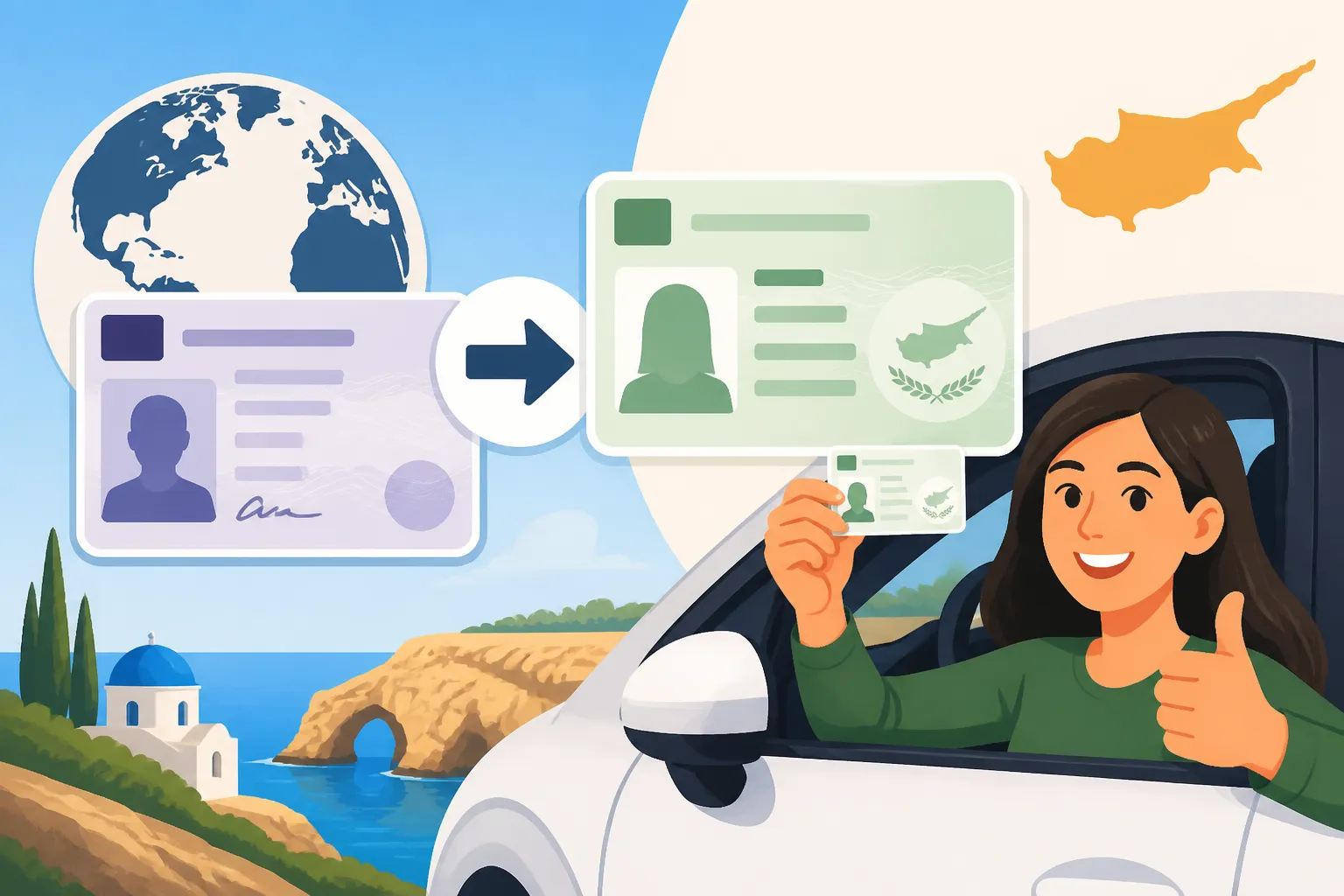
Now, if you're a third-country national – meaning from outside the EU/EEA – the rules are a lot stricter, and the conversion is definitely not optional if you plan to stay long-term. Generally, your foreign driving licence is valid for a period of up to six months from your date of arrival in Cyprus. After this grace period, you are legally required to convert it to a Cypriot driving licence. Trying to drive on your original licence beyond this six-month window can lead to significant problems, including hefty fines and invalid insurance.
The six-month rule is often a source of stress for newcomers. You're trying to find a job, sort out your residency, and get your new home set up – and suddenly, a ticking clock appears on your driving ability. It’s crucial to start this process well within that initial period, especially because government department processing times can sometimes stretch out. For more general advice on getting settled, you might find our guide on The Complete Guide to Moving to Cyprus: Your First 90 Days particularly helpful. This conversion for non-EU/EEA licences typically involves more stringent checks and, depending on the reciprocal agreements between Cyprus and your home country, might even require you to take a practical driving test.
Eligibility and Documentation: Getting Your Ducks in a Row
So, you know you need to convert. Great. The next step is gathering the right documents – and this is where the Cypriot bureaucracy can feel like a labyrinth. It’s absolutely essential to be meticulous here, as a single missing paper or incorrect translation can send you right back to square one, prolonging the wait and testing your patience. I've been there, staring at a form wondering which box applies to my specific situation, so take a deep breath and let's break it down.
Essential Documents for the Application
Regardless of whether you're from an EU/EEA country or a third country, there's a core set of documents you'll need to present. Think of this as your foundational packet. First off, you'll need your Alien Registration Card (ARC), often known as your 'Pink Slip' or 'Yellow Slip' (for EU citizens, officially the MEU1). This proves your legal residency in Cyprus, which is a non-negotiable requirement for obtaining a Cypriot driving licence. Without valid residency, they won't even look at your application. Next, bring your original foreign driving licence. They will need to see this to verify your driving entitlements and its authenticity.
You'll also need a recent passport-sized photograph, usually 45mm x 35mm. Make sure it adheres to official requirements – no smiling, plain background, good quality. Additionally, a medical certificate from a registered doctor in Cyprus is required, confirming that you are fit to drive. This is typically a standard form that your GP will fill out after a brief check-up. Finally, you’ll need a form TOM 7D (for exchanging a licence issued by an EU member state) or form TOM 7B (for exchanging a non-EU licence or initial application if you need to take tests). These are available at the Department of Road Transport (DoRT) offices or sometimes online. Don't forget your passport for identification and proof of age.
For third-country nationals, there are often additional requirements. You'll need an official translation of your foreign driving licence if it's not in Greek or English. This translation must be done by the Press and Information Office (PIO) or a sworn translator registered with the Cypriot courts – not just any translator. Furthermore, depending on the country, you might need a letter from your country's embassy or consulate in Cyprus, confirming the validity and categories of your licence. This is particularly common for countries without a direct reciprocal agreement with Cyprus for licence exchanges. It's a bit of an extra step, but absolutely necessary to ensure your application is processed without hitches. Remember to check the specific requirements for your nationality, as these can vary.
The Importance of Official Translations and Authentications
I cannot stress enough the importance of getting your translations and authentications done correctly in Cyprus. This isn't the time to cut corners. If your original driving licence isn't in Greek or English, you absolutely must get an official translation. This usually means going through the Press and Information Office (PIO) in Nicosia, or using a sworn translator who is registered with the district courts in Cyprus. A translation from a random agency back in your home country, or even from a friend who speaks Greek, simply won't be accepted. The PIO has specific procedures and takes a few days, so factor this into your timeline.
The purpose of these official translations and authentications is to ensure that the Cypriot authorities can fully understand and verify the details of your foreign licence, including the vehicle categories you are qualified to drive (e.g., car, motorbike, lorry). It's their way of making sure you're legally entitled to drive what you claim. Without this proper authentication, your application will be rejected, forcing you to restart and potentially losing valuable time, especially if you're up against that six-month deadline for non-EU licences. When you're dealing with anything official here, always assume they want documents to be impeccably presented and officially stamped.
The Step-by-Step Conversion Process
Once you've gathered all your documents, the real adventure begins: the application itself. This isn't an online process for driving licence conversions, so prepare for a visit to a physical government office. Knowing what to expect can significantly reduce stress and help you navigate the system more effectively. Staying connected during this time is essential, whether it's checking opening hours or getting directions; I personally rely on an eSIM from Airalo when I'm out and about dealing with paperwork, it saves faffing with local SIMs.
Navigating the Department of Road Transport DoRT
The Department of Road Transport (DoRT), or Road Transport Department (RTD) as it's also commonly known, is where the magic (or the waiting) happens. You'll need to visit one of their district offices. Major cities like Nicosia, Limassol, Larnaca, and Paphos each have one. Before you go, it's a good idea to check their current opening hours and any specific requirements for appointments, as these can change. Walk-ins are generally possible, but prepare for potential queues, especially first thing in the morning or just after lunch.
When you arrive, you'll usually be directed to a specific counter for driving licence applications or exchanges. This is where you'll hand over your meticulously prepared stack of documents. The official will review everything, often quite thoroughly, looking for any discrepancies or missing items. Be polite, patient, and have all your originals ready, alongside any photocopies they might require. It’s not uncommon for them to request an additional copy of something you thought you already provided, so a small folder with extra copies of everything is a lifesaver.
The Application Form and Fees
The application form itself (TOM 7B or TOM 7D) is relatively straightforward, asking for personal details, your current licence information, and residency details. Fill it out clearly and accurately. If you have any doubts, don't hesitate to ask the DoRT staff for clarification, although be prepared for varying levels of English proficiency. It's better to ask than to fill it in incorrectly.
Along with your application, you'll need to pay a fee. The fee for exchanging a foreign driving licence is generally quite reasonable, but it's important to confirm the exact amount beforehand, as fees can be updated. As of my last check, it's typically around €50 for the licence itself, plus a small administrative fee. Make sure you have cash or a card ready, as payment methods can vary by office. They'll issue you a receipt, which you should keep safe. This receipt often serves as temporary proof that your application is being processed, which can be useful if you're stopped by police before your new licence arrives.
What to Expect After Application
Once your application is submitted and fees paid, the waiting game begins. The processing time can vary significantly, from a few weeks to a couple of months, depending on the time of year, the specific DoRT office, and how busy they are. For non-EU licences, if a driving test is required, they will inform you of the arrangements. During this period, you will usually receive a temporary driving permit or your receipt will serve as proof, allowing you to continue driving legally. Make sure you understand exactly what documentation permits you to drive while you wait for your new card.
Eventually, you'll receive a notification, either by post or sometimes an SMS, informing you that your new Cypriot driving licence is ready for collection. This will typically be at the same DoRT office where you submitted your application. When you go to collect it, bring your identification (passport and ARC) and any temporary permit they issued. They'll hand over your shiny new Cypriot licence, which will look quite similar to an EU driving licence. At this point, your journey from foreign driver to fully licenced Cypriot driver is complete! You might find our post on How to Get a Cypriot Driving Licence helpful for more details once you're ready to make the full switch.
Common Challenges and Insider Tips for Expats
Let's be real: bureaucracy anywhere can be a pain, but in Cyprus, it sometimes comes with its own unique flavour of charming inefficiency. Anticipating these challenges and arming yourself with a few insider tips can make the licence conversion process much smoother.
Overcoming Language Barriers and Bureaucracy
One of the most frequent frustrations for expats is the language barrier. While many government officials in Cyprus speak English, especially in the larger cities, you might encounter staff with limited English proficiency, particularly in smaller offices or during busy periods. This can make clarifying specific requirements or understanding instructions a real challenge. My top tip here is to come prepared. Have all your documents organised, clearly labelled, and ideally, know the key Greek terms for "driving licence," "application," "exchange," etc. Even a simple "Parakaló, miláte Angliká?" (Please, do you speak English?) can go a long way.
Beyond language, the bureaucratic process itself can feel opaque. It's not always clearly signposted, and what seems logical in one country might not be how things are done here. Patience is truly a virtue. Avoid going on Mondays or Fridays, which are often the busiest days. Early mornings, shortly after opening, can sometimes be quieter. If you're struggling, don't be afraid to politely ask for someone who speaks English, or even consider bringing a Greek-speaking friend or colleague along if you're really stuck. Sometimes, just having someone who understands the nuances of local communication can save hours of frustration.
Temporary Driving Solutions and What to Avoid
While your licence conversion is pending, knowing your rights and legal temporary solutions is critical. As mentioned, most non-EU/EEA licences are valid for six months from your arrival date. During this time, carry your original licence, your passport, and your residency permit (Pink Slip/Yellow Slip) at all times while driving. If your application has been submitted and you're within or just past the six-month mark, the receipt from the DoRT often acts as proof of application and temporary permission to drive. Always confirm this with the DoRT when you apply, and make sure you understand what document legally allows you to drive.
What you must avoid is driving without valid documentation beyond the permitted periods. Driving on an expired foreign licence or after the six-month grace period without a pending application can result in severe penalties, including fines, points on your non-existent Cypriot licence, and even seizure of your vehicle. More importantly, your insurance might be invalidated, leaving you personally liable in the event of an accident. It's simply not worth the risk. If you absolutely need to drive and are between permits, consider hiring a car using your valid foreign licence (if within the grace period) or public transport until your new licence arrives.
Keeping Your Original Licence vs. Full Conversion
For EU/EEA citizens, you have the option to keep your original licence and just register it with the Cypriot authorities, rather than fully exchanging it. However, if you do decide to exchange it for a Cypriot one, be aware that your original licence will be sent back to the issuing country. This means you won't have both. This isn't usually an issue, as the Cypriot licence is valid across the EU/EEA, but it's something to consider if you travel frequently back to your home country and prefer to have your familiar licence.
For non-EU/EEA citizens, a full conversion almost always means your original foreign licence is surrendered to the Cypriot authorities and potentially sent back to its country of origin. This is a common practice to prevent individuals from holding multiple valid licences across different jurisdictions. Therefore, once you have your Cypriot licence, that will be your primary and only legal driving document in Cyprus. It’s a definite shift, but one that ensures you're fully integrated into the local system.
Driving in Cyprus with Your New Licence
Congratulations, you've got your Cypriot driving licence! That's a huge hurdle cleared. Now, you're officially part of the Cypriot driving community, and while the physical licence is new, the rules of the road and the local driving culture are aspects you'll continue to adapt to. This is where your new licence truly comes into play, enabling you to fully embrace life on the island.
Understanding Cypriot Driving Laws and Culture
Cyprus drives on the left-hand side of the road, just like the UK, Australia, and a few other countries. If you're coming from a right-hand drive country, this will be second nature. If not, it requires a significant adjustment, not just for you but also for your brain, which has to rewire itself for roundabouts and merging traffic. Road signs are generally in both Greek and English, making navigation somewhat easier, but don't assume every sign will be bilingual, especially in more rural areas.
Speed limits are strictly enforced, particularly in urban areas and major highways. The general limits are 50 km/h in urban areas, 80 km/h outside urban areas, and 100 km/h on motorways. Always be aware of speed cameras (both fixed and mobile) and traffic light cameras. Local driving culture can sometimes feel a bit… spirited. Expect honking (often as a greeting, sometimes as a warning), aggressive merging, and occasionally questionable parking. Defensive driving is a must. Knowing the ins and outs is covered more extensively in our guide, Driving in Cyprus: Licences, Registration and Rules for Expats.
Vehicle Registration and Insurance Requirements
Having a valid Cypriot driving licence is just one piece of the puzzle. If you own a car, you also need to ensure it's properly registered and insured. All vehicles in Cyprus must have valid road tax, which is renewed annually, and compulsory third-party liability insurance. Without these, your vehicle is not legal to be on the road, regardless of your licence status.
The process of How to Register and Tax a Vehicle in Cyprus involves a visit to the DoRT for registration, and then you can pay your road tax online or at banks. Car insurance is readily available from numerous local and international providers. It's mandatory to have at least third-party insurance, but many expats opt for more comprehensive coverage for peace of mind. Make sure your insurance policy is valid and always kept with your vehicle, along with your registration documents. And remember, regular vehicle maintenance and passing the MOT (Ministry of Transport) test are also crucial for ensuring your car is roadworthy and legal. For deeper insights into insurance, check out Understanding Car Insurance, Road Tax and the MOT in Cyprus.
| Document Type | EU/EEA Citizens (Exchanging) | Non-EU/EEA Citizens (Converting) | Notes |
|---|---|---|---|
| Application Form | TOM 7D | TOM 7B | Obtainable at DoRT offices or online. |
| Original Licence | Yes (valid EU/EEA driving licence) | Yes (valid non-EU/EEA driving licence) | Will be surrendered; returned to issuing authority (EU/EEA) or possibly kept by DoRT (non-EU/EEA). |
| Residency Proof | Yellow Slip (MEU1) or equivalent ARC | Pink Slip (ARC) or other valid residence permit | Must show legal residency in Cyprus. |
| Passport | Yes | Yes | For identification and age verification. |
| Passport Photo | 1 recent, 45x35mm | 1 recent, 45x35mm | Adhere to official specifications (plain background, no smiles). |
| Medical Certificate | Yes (from a registered Cypriot doctor) | Yes (from a registered Cypriot doctor) | Standard form completed by your GP after an eye test and general health check. |
| Official Translation | Not typically required if licence is in English | Mandatory if licence not in Greek or English | Must be done by PIO or sworn translator registered with Cypriot courts. |
| Embassy Letter | Not typically required | Often required (confirm for your nationality) | Letter from your embassy/consulate confirming validity and categories of your licence. |
| Driving Test | Not usually required | Required for certain non-EU countries without agreements | Depending on reciprocal agreements between Cyprus and your home country. |
| Fee | Approx. €50 (licence issue) + administrative fees | Approx. €50 (licence issue) + administrative fees (and test fees if applicable) | Confirm current fees at DoRT office. |
Disclaimer
The information provided in this guide is for general informational purposes only and does not constitute legal advice. While we strive to keep the information up-to-date and accurate, regulations and procedures in Cyprus can change without prior notice. It is always recommended to consult with the relevant Cypriot authorities, such as the Department of Road Transport (DoRT) or a legal professional, for the most current and specific requirements pertaining to your individual circumstances.