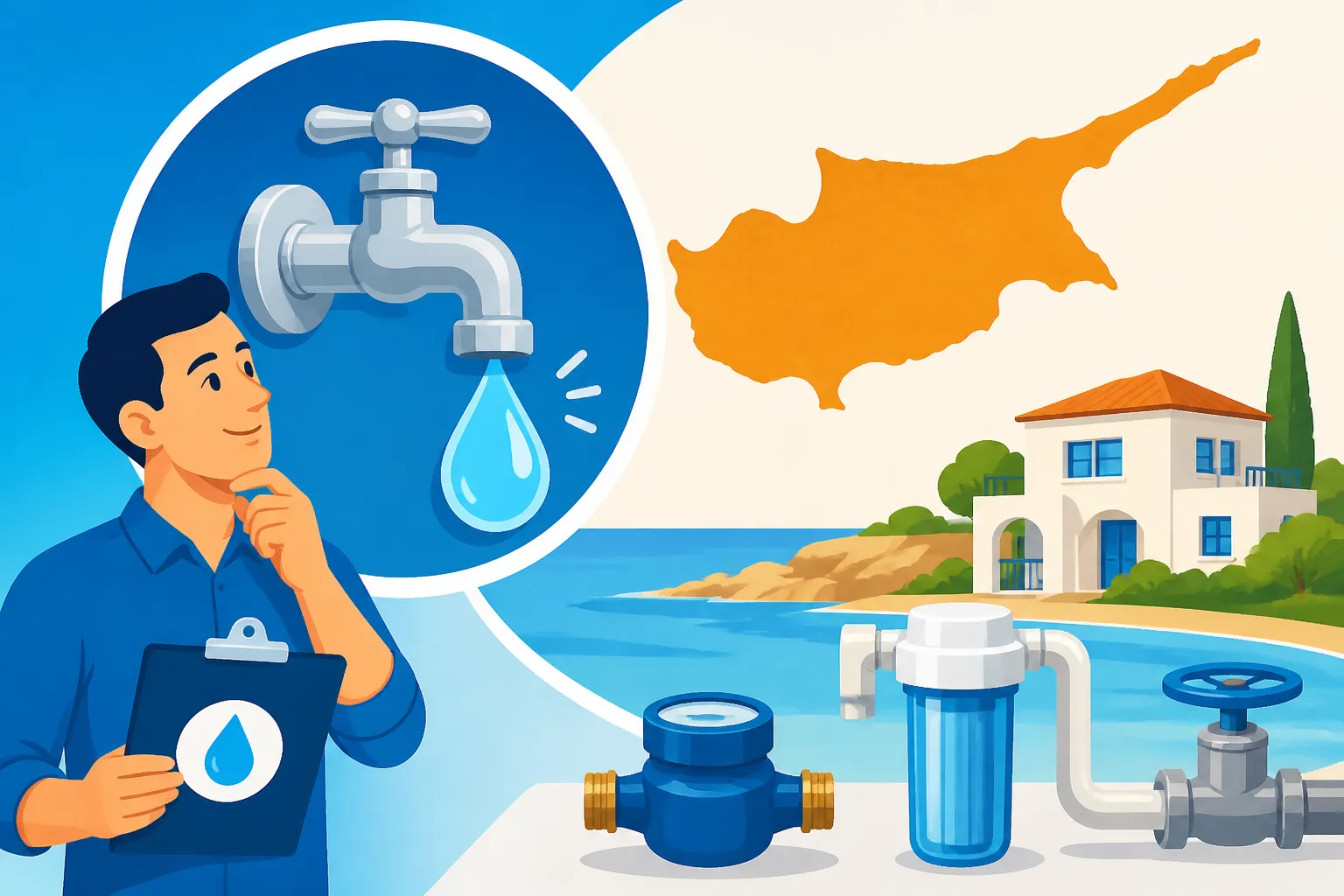
How Do I Set Up Water Supply in Cyprus?
Ah, the joys of setting up house in a new country! I remember it like yesterday, standing in front of my new (old) Cypriot home, buzzing with excitement, only to be hit by the sudden realisation that I had no idea how to get the water flowing. It’s one of those essential tasks that seems straightforward on paper but can feel like a labyrinth of paperwork and processes when you’re an expat. This guide is here to walk you through exactly how to set up your water supply in Cyprus, making sure you don't end up bone-dry.
Understanding Water Supply in Cyprus
Before we dive into the nitty-gritty of paperwork, it's really helpful to grasp how water is managed on this beautiful island. It's not just about turning on a tap; there’s a system behind it, and understanding it can save you a lot of head-scratching later on.
The Water Boards: Who Are They?
Unlike some countries where water might be managed by a national provider, Cyprus operates through a series of municipal Water Boards. These are essentially local authorities responsible for the distribution, billing, and maintenance of the water supply in their respective areas. This means that if you're moving to Limassol, you'll be dealing with the Water Board of Limassol. If you're in Nicosia, it's the Water Board of Nicosia, and so on. It's a localised system, which often means slightly different procedures or forms depending on where you are.
The good news is that these boards are generally well-organised, even if the bureaucratic pace can sometimes test your patience. They are the gatekeepers to your water supply, so building a good, albeit professional, relationship with your local board is key. They handle everything from initial connections to meter readings and resolving any issues you might encounter. Don't expect a seamless, digital-first experience everywhere; sometimes, a trip to the office with physical documents is still the order of the day.
Where Does Cyprus's Water Come From?
It might seem like a trivial detail when you're just trying to get a shower, but understanding Cyprus's water sources can actually give you a deeper appreciation for the resource and why conservation is so important here. Cyprus is an arid island, and fresh water has always been a precious commodity. Historically, the island relied heavily on rainfall collected in dams. However, with increasing population and demand, especially in the booming expat communities, this wasn't enough.
Today, a significant portion of Cyprus's potable water comes from desalination plants. These plants convert seawater into fresh water, a technologically intensive and costly process, but one that has secured the island's water supply. This reliance on desalination is why water can sometimes feel a bit more expensive than in other countries you might have lived in, and why you'll often hear calls for water conservation. It's not just about saving money; it's about respecting a hard-won resource. Knowing this can help you adjust your habits and understand the local emphasis on not wasting water, which is something I’ve certainly learned to appreciate over the years.
Step-by-Step Guide to Connecting Your Water Supply
Now, let's get down to brass tacks. Connecting your water supply is a multi-step process that requires a bit of preparation and, yes, some legwork. Don't worry, it's completely doable, but a little foresight can save you a lot of frustration.
Gathering Your Documents
This is often the first hurdle for many expats, and it’s where you’ll probably feel that familiar sigh of "more paperwork!" However, having everything in order before you even step foot in the Water Board office will significantly smooth the process. Think of it as your administrative toolkit.
Typically, you'll need:
- Proof of Identity: Your passport is usually sufficient. Make sure it's valid, and it's always a good idea to have a few photocopies handy.
- Proof of Residence/Occupancy: This is crucial. If you're renting, you'll need your rental agreement (signed and stamped if required, ensure your landlord has done their part). If you've bought property, you'll need the sale agreement or the title deeds in your name. Sometimes, if the title deeds are still with the developer, a signed and stamped sales agreement is what they’ll accept. It's worth calling ahead to your specific Water Board to confirm their exact requirements, as they can vary slightly.
- Property Details: The exact address of the property, including the plot and sheet number, if you know it. This information is usually on your rental agreement or sales contract.
- Existing Water Meter Number (if applicable): If there was already a water meter at the property, having its number can speed things up, especially if you're just transferring the account into your name.
- Tax Identification Number (TIN): If you've already sorted out your tax residency, you'll have a TIN. This is increasingly required for various official services, including utilities. If you haven't got one yet, you might be asked to apply for one, though for initial water connection, sometimes another form of ID or just stating your intention to register for one is accepted temporarily. For more information, check out our guide on How to Get a Tax Identification Number as a Foreigner in Cyprus.
- Yellow Slip / Pink Slip: Your residence permit (Pink Slip for non-EU, Yellow Slip for EU citizens) is often required as proof of your legal residency status in Cyprus. This shows you're not just a tourist trying to set up utilities!
It’s an excellent habit to make photocopies of everything. And I mean everything. Two copies of each document, sometimes even three. They often ask for them, and trying to find a photocopy shop in a hurry can be stressful.
Here's a quick rundown of typical documents:
| Document Type | Required For | Notes |
|---|---|---|
| Passport | Identity Proof | Valid, with photocopies. |
| Rental Agreement | Proof of Residence (renting) | Must be signed and stamped. |
| Sales Agreement/Title Deeds | Proof of Residence (owning) | For property owners; ensure it's in your name. |
| Property Address | Location Identification | Full address, including postal code. |
| Water Meter Number | Existing Connections | If transferring an existing account. |
| Tax Identification Number (TIN) | General Requirement | Increasingly important for all official services. |
| Yellow/Pink Slip | Residency Proof | Valid residence permit showing legal stay. |
Visiting Your Local Water Board
Once your dossier of documents is prepared, your next step is to physically visit your local Water Board office. Yes, in many cases, this isn't something you can do entirely online or over the phone, especially for a new connection or transfer.
Each major city (Nicosia, Limassol, Larnaca, Paphos, Famagusta) has its own Water Board. You need to go to the one corresponding to the municipality where your property is located. For instance, if you live in Germasogeia, a suburb of Limassol, you'll go to the Water Board of Limassol. The staff there are generally helpful and many will speak English, especially in the larger cities. Don't be shy about asking for an English-speaking representative if you're struggling.
When you arrive, you’ll typically take a number and wait. Depending on the time of day and the season, waiting times can vary. I’ve had quick five-minute waits and also agonizing 45-minute ones. Patience, my friend, is a virtue in Cyprus bureaucracy. Once called, you'll present your documents, fill out an application form (they'll provide it), and likely pay a connection fee and a deposit. The deposit is usually refundable when you eventually disconnect your service or move out, assuming all bills are paid. The connection fee is a one-off charge for setting up the service.
The staff will review your application, and if everything is in order, they'll process it. They’ll give you an estimate of when the water supply will be connected or the account transferred. It's rarely instantaneous, but usually within a few working days.
The Connection and Meter Installation
After you've successfully navigated the paperwork at the Water Board, the actual connection of your water supply is usually handled by their technicians. If you're in a newly built property or one where there was no previous water connection, they will need to install a water meter. This involves a technician visiting your property, installing the meter, and then physically connecting your property to the main water supply.
If you're simply transferring an existing account into your name (e.g., in a rental property where the previous tenant had water), the process is generally quicker. The meter is already there, and it's more of an administrative switch. However, even in this case, a technician might visit to take an initial reading and ensure everything is in order. You generally don't need to be home for the actual connection if the meter is outside and accessible, but it's always best to clarify with the Water Board when you apply. They’ll inform you if access to the property is required.
Keep an eye on your meter in the first few days. Make sure it's running when water is being used and not running when all taps are off (unless, of course, you have an automatic irrigation system). This can help detect any immediate leaks on your property, which could lead to unexpectedly high bills.
Managing Your Water Bills and Usage
Once your water supply is up and running, the next crucial step is understanding how your bills work and how to manage your consumption. This is where many expats get caught out, especially when coming from countries with different billing cycles or cost structures.
Understanding Your Water Bill
Your water bill in Cyprus is typically issued quarterly (every three months), though sometimes it can be bi-monthly in certain areas or for specific types of properties. It’s important to understand the components of your bill so you know what you’re paying for.
A typical water bill will include:
- Consumption Charges: This is the bulk of your bill, based on the amount of water you've used, measured in cubic meters (m³). Cyprus uses a tiered tariff system, meaning the more water you use, the higher the price per cubic meter becomes for subsequent tiers. This encourages conservation.
- Fixed Charge/Minimum Charge: A small fixed fee that is charged regardless of your consumption, just for having the connection.
- Sewage Charges: This is often included on the same bill, collected by the Water Board on behalf of the Sewerage Board (S.B.A. in Greek). It’s usually calculated as a percentage of your water consumption charge.
- VAT: Value Added Tax, currently at 19%, will be added to your total.
When you receive your first bill, take the time to review it. Compare the meter reading on the bill to the actual reading on your meter to ensure accuracy. If you spot a significant discrepancy, contact your Water Board immediately. They can send someone to re-check the meter.
Payment Methods and Deadlines
Paying your water bill in Cyprus is generally quite straightforward, with several convenient options available. The payment deadline is clearly stated on the bill, and it’s important to adhere to it to avoid late payment penalties or, in extreme cases, disconnection.
Common payment methods include:
- Online Banking: Most local banks (like Bank of Cyprus or Hellenic Bank) allow you to pay your Water Board bill through their online banking platforms. You'll need the unique reference number from your bill. This is my preferred method – quick, easy, and no queues!
- Direct Debit: You can set up a direct debit with your bank to automatically pay your bills. This is excellent for peace of mind, ensuring you never miss a payment. Just be sure to monitor your bills to ensure correct amounts are being debited.
- Water Board Offices: You can always pay in person at your local Water Board office during opening hours. Be prepared for potential queues.
- Banks: You can pay your bill at any local bank branch.
- JCC Smart: This is a popular online payment portal in Cyprus (www.jccsmart.com) where you can pay many utility bills, including water. You'll need to register, but it's a convenient one-stop shop for various payments.
- Post Offices: Local post offices also accept utility bill payments.
Remember, if you're ever struggling to pay or notice an error, contact the Water Board before the deadline. They are often more accommodating if you proactively communicate.
Conserving Water: Tips for Expats
As I mentioned, water is a precious resource here, and conserving it isn't just good for your wallet, it’s also environmentally responsible. Plus, with the tiered billing system, being mindful of your usage can genuinely keep your costs down.
Here are a few tips I've picked up over the years:
- Fix Leaks Promptly: Even a small drip can waste a surprising amount of water over time. Regularly check your taps, toilets, and any outdoor irrigation for leaks. A constantly running meter when no water is being used is a tell-tale sign of a leak.
- Efficient Appliances: When buying new appliances like dishwashers or washing machines, look for water-efficient models.
- Shorter Showers: Simple, but effective.
- Water Gardens Wisely: If you have a garden, water in the early morning or late evening to minimise evaporation. Consider drought-resistant plants that thrive in the Cypriot climate.
- Don't Let the Tap Run: Turn off the tap while brushing your teeth, shaving, or washing dishes by hand.
- Collect Rainwater: If you have a suitable setup, collecting rainwater for garden use is an eco-friendly option, though less common for urban apartments.
By being mindful, you not only reduce your personal expenditure but also contribute to the sustainable management of Cyprus's vital water resources.
Troubleshooting and Important Considerations
Even with the best preparation, things can sometimes go sideways. Knowing how to handle common issues and understanding a few additional considerations can make your life as an expat much smoother.
Dealing with Leaks and Emergencies
Imagine this: you wake up to a strange gurgling sound, and suddenly, there's water where it shouldn't be. What do you do?
- Internal Leaks (within your property): If the leak is past your meter and within your property, it's generally your responsibility (or your landlord's if you're renting and it's a structural issue). Turn off your main water valve immediately. This valve is usually located near your water meter or where the main supply enters your house. Then, contact a plumber. For smaller issues, your landlord might have a preferred plumber. For emergencies, you can find 24-hour plumbers in larger towns.
- External Leaks (before your meter or in the street): If you suspect the leak is before your meter (e.g., the meter is spinning wildly even when your main valve is off) or on public property (like a burst pipe in the street), this is the responsibility of the Water Board. Call their emergency line immediately. Each Water Board has a dedicated emergency number, usually listed on their website or on your bill.
It's a good idea to know the location of your main water shut-off valve as soon as you move into a new place. This simple bit of knowledge can prevent a lot of damage and stress in an emergency.
Relocating or Disconnecting Your Water Supply
Life happens, and sometimes you need to move to a new area or even leave Cyprus entirely. Disconnecting or transferring your water supply needs to be handled correctly to avoid ongoing charges or issues with your deposit.
- Moving to a New Property in the Same Municipality: If you're moving within the same Water Board's jurisdiction, you can often simply transfer your account to the new address. You’ll need to visit the office again, provide your new rental agreement or property details, and they’ll arrange the transfer. Ensure you get a final reading at your old property and an initial reading at your new one.
- Moving to a Different Municipality: If you’re moving from, say, Limassol to Paphos, you'll need to disconnect your service with the Limassol Water Board and then apply for a new connection with the Paphos Water Board. It's essentially starting fresh.
- Leaving Cyprus: If you're leaving the island for good, you'll need to formally disconnect your service. Visit the Water Board office, inform them of your departure date, and they will arrange a final meter reading. Make sure all your outstanding bills are paid, and they will process the refund of your deposit. This is a crucial step to avoid any lingering financial ties. Remember that settling your affairs fully, including utility disconnections, is part of a complete relocation process, often managed with the help of services like Sirelo, who can assist with moving logistics.
Don't just leave your water account active when you move out; you could be liable for future consumption, even if new tenants move in. Always ensure a proper disconnection or transfer.
Common Expat Frustrations
Let's be real, setting up utilities anywhere new can be a pain, and Cyprus isn't entirely exempt from the bureaucratic dance. It’s okay to feel frustrated, and frankly, validating those feelings is part of the expat experience.
- The Language Barrier: While many Water Board staff speak English, especially in the bigger cities, you might occasionally encounter someone who doesn't. This can lead to misunderstandings, so consider bringing a Greek-speaking friend or a translation app if you're not confident.
- Paperwork Overload: The sheer volume of documents and the requirement for physical copies can be tedious. This is where that 'photocopy everything' advice really comes in handy.
- Waiting Times: As mentioned, queues can be long. Try to go during off-peak hours (mid-morning or early afternoon, avoiding lunch breaks and end-of-day rushes).
- Different Expectations: Coming from a country with highly digitised, instant services, the Cypriot pace can feel slow. Try to adjust your expectations. Things will get done, just perhaps not on your preferred timeline. A deep breath and a smile go a long way.
Remember, every expat goes through this. It's a rite of passage! Once you have your water running smoothly, you'll feel a significant sense of accomplishment. It’s just one more step in making Cyprus truly feel like home. If you're also wondering about other vital connections, don't forget to check out our comprehensive guide on How to Set Up Electricity (EAC) in Your Cyprus Home and How to Set Up Internet and TV in Cyprus for equally helpful advice.
Disclaimer
The information provided in this guide is for general informational purposes only and does not constitute legal, financial, or professional advice. While we strive to keep the information up-to-date and correct, processes and requirements can change. It is always recommended to verify the latest regulations and requirements with the relevant authorities, such as your local Water Board or a qualified professional, before taking any action.